Hey, how's it going? Ready for another go? 'Course ya are, 'cause you're still reading.  We're going to take a look a look at a rather well known crazy looking animal. Mason suggested(or perhaps it was more of a passing mention) the ever popular....
Platypus (AKA Duck-Billed platypus) Ornithorhynchus anatinus
From the order Monotrema, consisting of only 5 species: 4 echidnas and just the 1 platypus. Platypi(my preferred plural, though platypuses or platypus are the more accepted ones) are awesome and widely known...but how much do you really know? Let's have a look.

"Hey, put me down!"
Physical Characteristics:
Adult male platypi measure on average 20in(~50cm) in total body length (bill tip to tail tip). They typically weigh 2.6-5.7 lbs(~1.2-2.6kg). The heaviest platypus recorded (from Tasmania) weighed in at 6.6lbs(~3kg). Adult females are smaller, measuring an average 17in(~43cm) in total body length and weighing 1.5-3.5 lbs(~0.7-1.6kg).
The platypus has a flattened, streamlined head and body. The fur is dark brown above (apart from a small light-colored spot just in front of each eye) while the chest and belly are silvery cream, sometimes marked with a tawny or reddish streak running along the animal's midline. It is extremely fine and very dense, with up to 900 hairs per square millimeter of skin. Its coat also has two layers: a woolly undercoat and longer, shiny guard hairs. These layers work together to trap a layer of air next to the skin, which keeps the body dry even when swimming.

A platypus presumably peeing on fish...you just can't tell, though. 
The tail is broad and paddle-like. The main function of the tail is to store up to 50% of the anima's body fat. It is also used as a stabilizer when swimming and as a tool for constructing burrows and helping to incubate eggs.
Like birds and reptiles platypi have only one posterior opening, the cloaca, used for both reproduction and elimination of wastes.
Platypi possess webbed feet. The front feet are totally webbed and are relied on almost exclusively for swimming. The back feet are only moderately webbed and are generally used for grooming. Males have a hollow, pointed spur (measuring 0.5–0.8 in [1.2–2 cm] in length) located on the ankle of each hind leg. This spur is used to deliver a venom, secreted by the crural gland, that is deadly to smaller animals. It is merely excruciatingly painful to humans.(So no worries, mate!  ) The platypus is one of few mammals to secrete venom.
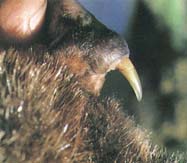
The spur of pain!
Its eyes and ears are located within shallow, muscular grooves on the sides of the head that automatically pinch shut when an animal dives which leaves it basically deaf and blind underwater, fortunately its most distinguishing and interesting feature, the duck-like bill, becomes the main tool used in finding food. Though it resembles a hard duck's bill, it is actually rubbery and covered with sensitive skin. It is used to perceive information about its environment and also used to move and pick up things. What is very unique, however, is that it is densely packed with tens of thousands of specialized sensory receptors, sensitive to either touch and vibration (push rods) or electrical currents (mucous sensory glands). It has been shown experimentally that the platypus is capable of registering the tiny amount of electricity generated in the water by the tail flick of a shrimp at a distance of around 2 in (5 cm). (Cool, huh?)
There are teeth in the bill early on in the platypus's life, but as the platypus grows the teeth are replaced by flat, molar-like grinding pads in the back of the mouth. These pads will constantly grow in order to keep up with wear and tear.
Habitat:
Present along the eastern and southeastern coast of mainland Australia (to about as far north as Cooktown, Queensland), and on Tasmania and King Island. An introduced population is also found on Kangaroo Island in South Australia.
It's semi-aquatic, found in freshwater habitats, including ponds, lakes, rivers, and streams at all elevations. The animals are not adapted to feed on dry land, and so are most commonly found in permanent water bodies. The species will also use manmade reservoirs as long as the water is not too deep, mainly feeding at a depth of less than 16.5 ft (~5m). The platypus is known to occur in both urban and agricultural areas.

Platypus pad.
Platypi residing along a stream or river typically have a home range comprising 0.5–6 mi (1–10 km) of channel. Home-range size varies with an individual's sex (males have bigger home ranges than females) and habitat productivity.
They don't swim around all the time, though. A platypus digs a burrow and chills out in there for most of the day. There are two types of burrows: nesting and camping. Nesting burrows are self explanatory, camping burrows are all others. Each burrow is only big enough to accommodate the resident(s). Nesting burrows are obviously larger than camping ones. The entrance is under or just above the waterline, usually covered by grass or some overhanging structure. The tunnel to the actual den is around 3.2-13.1ft.(1-4m)

It's a burrow. Can ya dig it?
Diet:
Carnivorous. It mainly eats bottom-dwelling aquatic insects such as caddis-fly and mayfly larvae. It also like worms, snails, freshwater shrimps and crayfish, and pea-shell mussels.
Stuff like this:


Platypi have to eat the equivalent to about 15-30% of their body weight each day.
Behavior:
Mainly nocturnal and as stated before, semi-aquatic. Observation of this species is difficult because of that and a lot of research into their behavior has been done with radio-tracking.
The platypus is essentially solitary, though three or four animals may occasionally be found foraging within a few dozen yards (meters) of each other at a spot where food is abundant. They may find food by digging under banks or snagging prey floating on the water surface, as well as searching along the bottom sediments. Small prey is stored temporarily in cheek pouches while an animal is submerged. A foraging platypus typically remains underwater for 10–60 seconds before returning to the surface to breathe and chew its meal with a side-to-side motion of the jaws. When a platypus is not feeding, it spends up to 17 hours a day resting in its burrow.
The webs of the feet are folded under the foot when the platypus is out of the water, making it easier for the animal to walk and use its strong claws for digging burrows. The highly specialized front feet are not adept at removing objects that become caught around the head or body. As a result, platypus can die after becoming ensnared in litter such as loops of nylon fishing line or plastic six-pack holders. (So don't f&$%in' litter!) The back legs are used to groom the fur to keep it neat and waterproof. The legs extend out to the side of the body and while good for digging and swimming/ Walking isn't graceful. The tend to shuffle like a lizard when walking on land or crossing shallow areas of water, which makes them vulnerable to predators.
They will make a soft growling sound when disturbed.
Some individuals may periodically enter a state of torpor in which the animals allow their body temperature to drop, remaining inactive for up to about six days. This only seems to happen during colder months.
Hot platypus love takes place around August to October, perhaps as early as July in warmer regions. Mating will take place in the water and is initiated by the female. Courtship involves two individuals swimming alongside or circling each other, sometimes accompanied by nuzzling or rubbing. One animal may use its bill to grasp the tip of the other's tail and be towed or swim behind.
The platypus, being a monotreme, is one of the few mammals that lay eggs. After mating, it takes around a month for the female to lay her clutch of 1-3 eggs. The female will line her nesting burrow with plant matter and plug up the entrance with dirt a few days before laying begins to hide from predators and prevent death due to possible flooding. The eggs have thin, leathery shells similar to reptiles and are about 0.6-0.71 in (~1.5-1.8cm) long. The mother is believed to incubate them between her lower belly and curled-up tail for a period of about 10 or 11 days. The young are naked when hatched and are called 'puggles.' (Though that term seems to be more appropriate for echidnas...but what the hell, I'll use it for now)
The female platypus doesn't have nipples, but secretes milk from pores on her belly, which the young will lap out of her fur with sweeping motions of their bills. They will continue to develop in the nursery burrow for about four months before entering the water for the first time. Throughout this period, they are nourished solely on milk. Two weeks after their first venture outside the burrow they become independent and also somewhere around this time, they loose their teeth and grow those grinding pad structures. More research is required to establish the animals' typical life span in the wild. The longest lived platypus recorded in the wild was 16 years old.

Tiny platypus egg. Not a good breakfast item.

Puggles like to to snuggle.
Interesting Facts:
The platypus is considered a throwback to reptile-like mammals because of its egg laying ability and nursing of the young. It is an offshoot of the evolutionary line that led to marsupials and placental mammals.
Platypuses were shot and trapped extensively in the early 1900s for their fur until legislation protected them.
According to Aboriginal legend, the first platypus were born after a young female duck mated with a lonely and persuasive water-rat. The duck's offspring had their mother's bill and webbed feet and their father's four legs and handsome brown fur.
"Platypus" means flat-footed.
Early British colonists in Australia called the platypus a "water mole" or "duck mole."
In 1799, the platypus was first described by a British scientist, Dr George Shaw. His initial reaction to this original specimen was that it was an elaborate hoax. He even took a pair of scissors to the pelt, expecting to find stitches attaching the bill to the skin.
A healthy platypus maintains its body temperature at around 89–90°F (32°C).
Platypi once swam around with dinosaurs. In Argentina, fossil remains prove that they existed at the time when the South American and Australian land masses were joined in the super-continent Gondwana. A fossil jaw 110 million years old of a platypus prototype was found in New South Wales. However, this animal was almost twice as big and had teeth unlike the modern version. This was possibly the largest mammal in the world at that time.
The platypus has extra bones in the shoulder girdle, including an interclavicle, which is not found in other mammals.
Researchers have discovered that it has 10 sex chromosomes, some of them linked to mammals and some to birds.
The Australian 20 cent coin features a platypus. Which I have to say is a hell of a lot better than buildings and presidents' heads. More animals on U.S. currency, I say!

So what's up with the 20 cent piece anyway? A 1/5 of a dollar...why not use 25 cent pieces? Or do you have both?
Well, that's the platypus. 

Dive! Dive! Dive!
~Zoo
