Well, the first was well received(I got featured, baby.  ). What can I say? People love animals.
So we'll continue this little series with Maso's suggestion....
The Bilby! (AKA Rabbit-eared Bandicoot, Greater Bandicoot, Dalgite) There were two species, the Greater Bilby, Macrotis lagotis and the Lesser Bilby, Macrotis leucura. Unfortunately the Lesser Bilby is now extinct.  The surviving bilby is a threatened species, very threatened. (
The Bilby is part of the family Peramelidae which includes all extant(living) species of bandicoots.

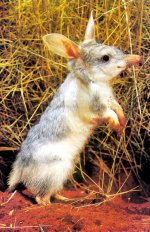
Yes, stare into the eyes of chaos! Okay, it's adorable if very weird looking.
Physical Characteristics:
The bilby is about the size of a rabbit. Head and body length: 9–10.2 in(23–26 cm); tail 7.8–11.4 in (20–29 cm). It weighs around 28–88 oz (800–2,500 g). It possesses very large leathery rabbit-like ears, powerful digging claws, silky blue-gray fur, and a long, thin, snout. As you can see, the tail has a characteristic black and white color pattern: black from the base to the middle and white from there to the tip.
The claws are only on three toes of the five toes of the front feet. The bilby is a marsupial like all other bandicoots. The pouch faces backwards and contains 8 teats.
They have a great sense of smell and hearing to compensate for poor eyesight, useful for hunting and avoiding predation.
Habitat:
Found only in Australia. Inhabits desert and scrub land for the most part. Also found in wooded areas, but without thick ground cover. It needs a lot of room for foraging.
It was estimated that once the bilby could be found on around 70% of the Australian landmass, but after the Europeans came their numbers were severely reduced due to trapping, introduction of feral species(rabbits, foxes, and cats), and loss of habitat. They currently exist in fragmented populations across Australia, notably in the Tanami Desert of the Northern Territory; the Gibson and Great Sandy Deserts and Pilbara and Kimberley regions of Western Australia; and isolated areas in southwest Queensland.

Diet:
Omnivorous. Main foods are various seeds, roots, insects, bulbs, fungi, and fruit. Local populations have different preferences based on where they live, most likely due to the abundance of a certain food item. The claws come in handy for finding insects which it laps up with its long tongue- 29-90% of its feces can consist of earth. They apparently gain all the moisture they need from the food they eat, for they have never been observed drinking water.
Behavior:
Nocturnal, venturing out to forage at least an hour after dusk and retreating an hour before dawn. They are solitary and only observed in groups when an abundant food source exists, though show no social cohesion. Males will show some territoriality by scent marking, but aggressive behavior towards other males has not been observed.
Bilbies are the only member of their family to burrow and can have up to 12 spiraling burrows in their territory each about 10ft (~3m) long. It never strays very far from an entrance and can run pretty fast, though a little awkwardly.
Females will mate with the dominant male in the area and give birth after about 14 days to 1-3 young. This can happen at any time of the year if the female wishes, but is usually limited by food availability and climate conditions. The young are less than a centimeter in length and will suckle inside the pouch for the next 80 days. After leaving the pouch, the young stay for another two weeks and continue to suckle. After that, they become independent but may stay in the mother's territory for awhile longer. The record lifespan for a bilby is is a little over 7 years.
Interesting Facts:
Seeing as how the bilby is in a good bit of trouble these days, a lot of people have been working towards getting the world out on these guys and organizations such as "The Australian Bilby Appreciation Society" have sprung up to help out.
Awareness is also spread around Easter when instead of the bastard feral rabbits, they celebrate with the native bilby. Also, people sell chocolate to raise funds for the little fellas...appropriately enough, in the shape of bilbies.

Delicious!
There is a highly successful bilby breeding program at Kanyana Wildlife Rehabilitation Centre, near Perth, Western Australia. So action is being taken, which is good.
They used to be hunted for food and fur by Aboriginal tribes, but have since become one of the premiere celebrities for Australia's threatened wildlife.
The name "bilby" is actually a borrowed word from the Yuwaalaraay Aboriginal language of northern New South Wales, meaning long-nosed rat.
~Zoo
