Yeah I took a little hiatus-but don't worry it's animal time, folks. Sit back, relax and get your learn on. My friend Alysha said I should write about one of the most popular animals on earth. The ever impressive and majestic.....
Lion Panthera Leo
*Note: There are six extant subspecies. The only notable difference is their geography and some physical variation. I'll mention notable differences here and there.
Lions hail from the family Felidae, which includes all cats, from the one on your lap to the one capable of devouring you. 

He will eat you, your family, your pets...and your soul!
Physical Characteristics:
They aren't called "big cats" for nothing. Males, from nose to base of tail, are around 5.6–8.2ft(~1.7–2.5m) long and 4ft(~1.23m) at the shoulder. Females(called lionesses) are smaller at 4.6–5.75ft(~1.4–1.75m) and 3.3ft(~1m) at the shoulder. The tail length is 2.3–3.3ft(~0.7–1m) for both sexes. Males weigh in around 417lbs(~189kg) on average, females weigh about 278lbs(~126kg). By no means are these the limits for these cats the longest male ever recorded was 10.8ft(~3.3m) long and the heaviest male recorded was 600lbs(~272kg). (That's a lot of cat!)
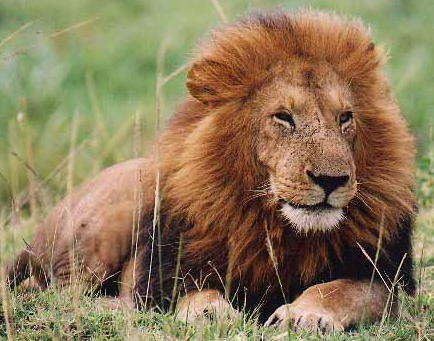
Big hunk of manliness.

His better half.
They have short, tawny coats, white underbelly, tufts of fur on the elbows, and their tails have a black tuft at the end. The tuft contains a small spine about 0.2in(~5mm) long, formed from the fusion of the last segments of the tail bone. They are sexually dimorphic and male lions are the only cats with manes. Three year-old males grow manes that vary in color from black to blond; the manes tend to be fuller in open habitats. Manes can also be nearly nonexistent in some cases.
Lions also have huge teeth and claws.  A canine tooth can be around 4.3in (~11cm) including the curve, large claws can be 3.15in(~8cm). (Not something you want chomping or scratching you.)
Lionesses are capable of reaching speeds of up to 40mph (~59km/h) but only in short bursts.
Leucism (reduced pigmentation, similar to albinism but eye color usually isn't affected) does occur in some populations.

Cubs have brown spots on a grayish coat until the age of three months; spots may remain on stomach of adults.
The Asiatic lion has less mane growth on top of the head and longitudinal fold of skin running along belly.
Habitat:
Most of Sub-Saharan Africa, excluding rainforests and deserts. The Asiatic lion,P. l. persica, lives in the Gir Forest in India.

Gir forest.
Open woodland, and mixed areas of thick bush, scrub and grass. Normally savannah and plains habitats are the most preferable, with sufficient cover. They can adapt to most any habitat, save for the previously mentioned harsh deserts or thick rainforests.

(Incidentally, you'll never guess how many girls named Savannah are in porn. Don't Google "savannah" if you're at work or school or anything.)
To be more specific:
P. l. senegalensis, known as the West African lion, is found in Western Africa, from Senegal to Nigeria.
P. l. azandica, known as the North East Congo lion, is found in the Northeastern parts of the Congo.
P. l. nubica, known as the East African- or Massai lion, is found in East Africa, from Ethiopia and Kenya to Tanzania and Mozambique.
P. l. bleyenberghi, known as the Southwest African- or Katanga lion. It is found in southwestern Africa, Zimbabwe, Angola, Katanga (Zaire).
P. l. krugeri, known as the Southeast African- or Transvaal lion, is found in the Transvaal region of South eastern Africa, including Kruger National Park.
Keep in mind that all of these are subspecies, not completely different species of lion. They can all interbreed, the only true differences are slight physical variations and geographic location.
Diet:
Carnivorous. They like meat, and they like a lot of it. Common prey items include but are not limited to: Thompson's gazelles, zebras, impalas, wildebeests, cape buffalo, giraffe, warthogs, hartebeests, birds, rodents, fish, ostrich eggs, amphibians and reptiles. They'll also take the opportunity to scavenge by stealing from vultures or hyenas or even other big cats.
Lions need about up to 15 lb (7 kg) of food per day, but feeding is often irregular and a male may eat 110 lb (50 kg) at one time.

i can has zebraburger? (Forgive me for that allusion.)
Behavior:
Mostly nocturnal, however daylight activity isn't unusual.
Lions are the most social of all cats living in groups called prides. Prides are made up of related females and their cubs as well as the male or males that rule over it. Pride size varies from two to 18 adult females depending on habitat and prey availability, but typically four to six. A single male or coalition of up to seven males, almost always unrelated to the females, holds sole control over the group, excluding other males from mating. Membership is stable, but individuals often scatter in sub-groups throughout the range, especially when foraging, and many lions spend considerable time alone.
Prides are strongly territorial. Males mark territory by urine-marking and by roaring, usually at night, when the sound can travel 5 mi (8 km). They actively patrol the edges of territory, whereas females tend to stay nearer the center. Males face strong competition for pride tenure, and average tenure is only two to three years (larger coalitions last longer).
Aside from the pride organization, there exists individual or groups of males that have been kicked out of their pride after reaching a certain age. They roam about sporadically unless they take over a pride, some live this way permanently. Pride takeovers are generally pretty violent leading to severe injury or death of the losing lions.
When resting, lion socialization occurs through a number of behaviors, and expressive movements are highly developed. The most common peaceful gestures are tactile and include head rubbing and social licking. Head rubbing—nuzzling one's forehead, face and neck against another lion—appears to be a form of greeting, as it is seen often after an animal has been apart from others or after a fight or confrontation. Males tend to rub other males, while cubs and females rub females. Social licking often occurs in tandem with head rubbing; it is generally mutual.
Lions have an array of facial expressions and body postures that serve as visual gestures. Their repertoire of vocalizations is also large; variations in intensity and pitch, rather than discrete signals, appear central to communication. Lion sounds include snarling, purring, hissing, coughing, meowing, and roaring. (By the way, that roaring when heard in person will intimidate the shit out of you.)
Females do most of the hunting with males getting involved to tackle larger, slower prey such as giraffe or buffalo. They will hunt cooperatively, fanning out to partially surround prey. More often only one or two lions hunt, while the remainder watch. The primary tactic is stalking to within a short range and dashing quickly. They kill prey by suffocation, clamping their strong jaws on an animal's wind-pipe or muzzle. (Lovely way to die, eh?)
Only one in four hunts are successful, with moonless nights having the best outcomes. Lions eat communally, but males always eat first before lionesses are allowed to eat, then cubs last of all. In lean times, cubs frequently die of starvation.
Dirty lion love is pretty much non-seasonal. They are polygamous, that definitely applies to the male and females may mate with more than one pride male if more than one is present. Females are sexually mature at 3 to 4 years, males at 4 or 5.. Mating occurs about 3 times per hour for several days. (Yeah, baby!) Although the male's penis does have those characteristic cat spines that rake the walls of the vagina. The first male member of a pride that reaches a female in heat has the mating priority over her. Fighting between pride members over females does not normally occur.
If a pride is taken over, it is to the successful male’s reproductive advantage to kill the suckling cubs of the defeated males. A nursing lioness that loses her cubs will come back into estrous within 2 to 3 weeks. The normal time between births is 2 years, which is the typical time for a male to rule a pride. Therefore, by killing all unweaned cubs at the time of pride takeover, males can ensure that they have some opportunity to father offspring of females who would otherwise not be available to them during their reign as pride leaders. Females will vigorously defend their cubs during a takeover and are sometimes killed also-it is possible for them to hide cubs successfully.
Gestation is around 110 days, litter size ranges from one to six cubs. Cub mortality can be very high, up to 75% in first year if prey is scarce. Cubs start to eat meat after three months, but nurse until six months. Males leave the pride at two to four years old (earlier if forced out by a pride takeover), most females remain in the pride. Eyes typically open by 11 days, cubs can walk by 15 days and are able to run by 1 month of age. Mother lions keep their cubs in hiding until they reach about 8 weeks of age. The cubs are weaned between 7 and 10 months, however they are dependent upon adults in the pride until they are at least 16 months old. It is fairly common for synchronous breeding and cross suckling, which is to say females produce litters at the same time and will allow cubs from other females to suckle from them. This is crèche behavior, a group taking care of all the young. Males don't assist in raising cubs, but will ferociously defend them as well as the rest of the pride.
Female lions typically live longer than males. Males reach their prime between five and nine years but few males survive past ten years of age. Some males have survived until 16 in the wild. Females normally live until 15 or 16 years. In captivity, lions live approximately 13 years. The oldest known was 30 years old.

AWWW!!!

CUTE!!!
(Everyone loves baby pictures.  )
)
Interesting Facts:
Lions are depicted in the art of many ancient cultures, including European cave paintings from more than 30,000 years ago.
Numerous African cultures still believe in the magical and healing properties of lion body parts.
The extinct Barbary lion was featured in the circuses of ancient Rome.
Lions are the second largest members of the cat family, tigers being the first.
Lions are actually pretty decent climbers and will rest in trees.
A good chunk of the day is spent laying around, sleeping, and resting. Approximately 21 hours a day.
The Asiatic lion is pretty damned endangered, the only safe refuge being Gir Forest. There is an estimated 300 of them left there.
Though not as notorious as tigers for maneating, lions do at times resort to attacking people-displaying great cunning and bravery, as seen in the case of Tsavo maneaters. The Tsavo maneaters, by the way, were a pair of maneless lions that attacked people working on the Kenya-Uganda Railway in 1898. They were called, "The Ghost" and "The Darkness." You might have seen the movie of the same title. They were thought to have killed around 135 people.
The Swahili word for lion, simba, also means "king," "strong," and "aggressive."
Most lions drink water daily if available, but can go four or five days without it. Lions in arid areas seem to obtain needed moisture from the stomach contents of their prey.
While lions may be majestic, powerful beasts some...just don't live up to expectations- like this poor bastard:

Well, there ya go guys. Okay, I won't leave you with the Cowardly Lion.
How about this?

A little art to end the article.
Thanks for reading.
~Zoo
