Woo! Number 15 coming up, guys...from my friend, Patrick, I now give you the awesomely named....
Volcano Rabbit (AKA Teporingo, Zacatuche, Conejo del Volcano, Mexican Pygmy Rabbit) Romerolagus diazi
It's in the family Leporidae, which contains all rabbits and hares.(approx. 50 species) This little guy is endangered, by the way. 

Apparently crossing volcanoes and rabbits yields something adorable, not the fire breathing hell rabbit I was expecting.
Physical Characteristics:
One of the smallest rabbits(the second smallest, actually) The body length is 10–14 in (27–36 cm). They weigh 14–18 oz (400–500g). The ears are short and rounded. The fur is short and thick; the back and sides are yellowish fur mixed with black and a good dose of brown, the base of the ears are buff colored, the underside is light buff with grey underfur. This rabbit lacks a visible external tail. The legs are also fairly short.
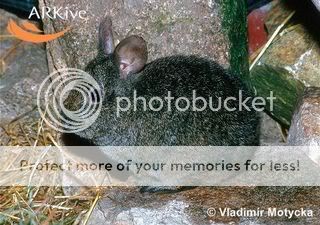
Yep, still pretty cute.
As with other rabbits, the longer ears are most likely an adaptation for detecting predators. They also have a strengthened pelvic girdle and powerful hind legs for hopping and jumping. Forelegs have five digits(including the dew claws), hind legs have four(all digits have claws). The forelegs are shorter than the hind legs and more stout. Rabbits move about on the tips of the digits in a fashion known as digitigrade locomotion.
They are hindgut digesters. This means that most of their digestion takes place in their large intestine and caecum. In rabbits, the caecum is approximately 10 times bigger than the stomach, and it, along with the large intestine, makes up roughly 40% of the rabbit's digestive tract.(This is important in diet, I'll explain in that section)
Lagomorphs(hares, rabbits, pikas) have ever-growing incisors, and thus need to chew to wear them down. They also have a large gap behind the incisors to the molars.
Special note: Though rabbits look remarkably like rodents, they are NOT. Rodentia is an order in itself, but rabbits and hares belong to a different one, Lagomorpha. 
Scent is very important in communication and a number of glands are on the bodies of rabbits. They will rub themselves on different surfaces and the smells give all kinds of information about the animal.
Habitat:
¿De dónde? ¡México! Specifically(and only) the slopes of the Iztaccíhuatl, Pelado, Popocatepetl, and Tlaloc volcanoes. The volcano rabbit is generally found between elevations of 1.75-2.6mi(~2.8-4.25km) in pine forests with a dense undergrowth of bunch grass ("zacaton") and rocky terrain.
Like most rabbits, it lives in burrows. The burrows can be as long as 5.5yd (~5m) and may be as much as 15.75in(~40cm) underground. The entrance is concealed at the base of a grass clump.

Oh yeah, grassy clump access, baby.
Diet:
Herbivorous. It feeds on the green leaves of zacaton grasses, the young leaves of spiny herbs and the bark of alder trees. During the rainy season, it may also eat oats and corn from crops.
Rabbits are also a tad unique when it comes to obtaining all the nutrients they need from their food. Like I mentioned above they're hindgut digesters. This means they produce cecotropes.
Cecotropes, sometimes called "night feces", come from the caecum and are high in minerals, vitamins and proteins that are necessary to the rabbit's health and are softer compared to the "real" feces. Rabbits eat these in order to meet their nutritional requirements. This process allows rabbits to extract the necessary nutrients from their food. In other words, rabbits will consume certain bits of their own poo again to extract all the nutrients from it. (Not so cute now, huh?  ) It's comparable to how cows chew cud....just a bit more disgusting.
Behavior:
Crepuscular and nocturnal. It likes the night life.  It will sometimes venture out in the daytime, often on overcast days. If it does come outside during the day and finds a sunny patch it is quite common to see this rabbit spread out on the ground to warm itself.
Unlike most other rabbits, it vocalizes quite a bit. Whereas other rabbits remain mostly silent and use foot thumps to communicate, this little guy gives off a high pitched call to warn others of danger and whatnot. Their calls resemble pika calls and at least 5 different ones have been described. They live in groups of 2-5 individuals. These rabbits also tend to paths through which they move, making runways through the grass.
Volcano rabbits probably breed throughout the year with a peak during the warm, rainy summer. Nests are shallow depressions hidden under a grass clump and lined with fur and plant fragments. Gestation lasts 38-40 days, litter size ranges from 1-3. Young, called 'kittens', are born completely furred(not all that common in rabbits), but with closed eyes which open in 4-8 days. Young remain in the nest for 14 days and begin to eat solid food and move about after three weeks. Lifespan is unknown.(according to my research)

(I don't have any baby pictures this time...sorry. ( It's still cute though. )
Interesting Facts:
Rabbits are incapable of vomiting due to the physiology of their digestive system.
This species is strictly protected, but it is nevertheless hunted by local people for its flesh or simply for sport. Urban sprawl is also a threat, specifically from Mexico City.
The only rabbit smaller than the volcano rabbit is the pygmy rabbit.
Rabbits can see behind them without turning their heads.
A rabbit's nose is a gauge for how interested it is in what's being observed. The faster the wiggling, the more attentive or agitated the rabbit is. Nose wiggle signaling is generally only used by rabbits that are already moderately relaxed.
What's the difference between rabbits and hares? There are two main ones(besides genetics and physiology and all that stuff)
1. their methods in avoiding predators (rabbits hide in dense vegetation or burrows; hares have longer legs and try to outrun predators)
2. the characteristics of their young at birth (newborn rabbits ("kittens") are born naked and with their eyes closed; newborn hares ("leverets") are better developed - their eyes are open and they can move around with some degree of coordination)
Females can undergo postpartum estrus, conceiving immediately after a litter has been born. (Yeah, they're prolific)
Rabbits were released on deserted islands to give shipwrecked sailors a food source until they could be rescued.
Rabbits can be litter trained and even perform clever stunts. One Japanese man raised a rabbit called Oolong and taught it to balance small objects on its head as it hopped along.
Some rabbits are vicious killers. (Definitely check this link out)

"What, behind the rabbit?" "It is the rabbit!"
Info is a little hard to come by on this species, probably due to the endangered aspect...wasn't too difficult, though. I just threw in some general rabbit information to flesh it out. Well, hope you had fun learning more about bunnies.
~Zoo
