Number 10, guys! Woo! This means I can now officially abbreviate my series. I'm still keeping the "Zoo's" part to make it easier to identify...but yeah, now it's abbreviated. Well, on to business. For my next animal, I've taken one of Maso's suggestions and now present to you, the reader, the....
Asian House Gecko (AKA Common House Gecko, Spiny-Tailed House Gecko) Hemidactylus frenatus
Cute little fellas that are a member of the appropriately named family, Gekkonidae. Geckos are awesome. 

"This is my log!"
Physical Characteristics:
Snout to vent length is around 2.6in (~6.5 cm) Total length including the tail is about 5.3in (~13.5cm) Can't find anything on the weight, but I'm going out on a limb and saying they're not that heavy. 
The body is flattened with soft, granular skin. The toe pads are divided, and the first digit is much smaller than the others. Each digit has a claw. The tail has enlarged ventral plates and a denticulate margin(in other words, a toothed edge. You can see the little spines along the tail in the above picture). These geckos are grayish, pinkish, or pale brown with darker flecks...a decent bit of color variation actually.
They have large eyes, but don't have eyelids. Instead eyes are covered by a transparent spectacle. They use their tongue to clean it. As you may notice, their pupils are vertical slits.
Also, their tail breaks off easily and can be replaced. It seems later generational tails don't possess the spiny edges that the first generation tail does.
The feet are the main attraction on these guys. They are flattened and are covered in broad plate-like scales. Each of those scales are covered with tiny bristles called 'setae.' If you venture an even closer look the setae are tipped with little pads called 'spatulae.' With all of that increased surface area, the foot is able to stick to vertical and upside down surfaces. It is thought they use 'van der Waals forces' (molecular interactions due to dipoles) to cling to the molecular structure of the surface they're walking on. (Is that not cool or what?  )
)
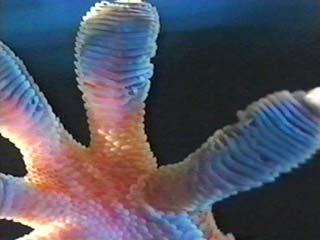
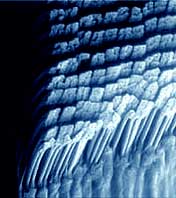
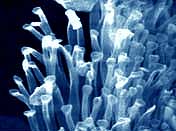
From left to right: toe scales, setae(the hairlike structures), setae with spatulae(pads on the tips)
All that enables the little guys to do this:

Hangin' out...vertically!
Habitat:
This is the most widely distributed lizard in the world. Originally from Southeast Asia, the Indo-Australian archipelago, the Philippines, Taiwan, Micronesia, Melanesia, and Polynesia they've ventured just about everywhere that the environment can support them. Basically every tropical and subtropical region. Some places they have colonized: Australia, eastern Africa, Mexico, and the Southern US and other places in between.
Without humans around they are arboreal. With humans they have become extremely urbanized and if there's a building, there will be geckos. Hence the name, "house gecko." They are also kept as pets.
Diet:
Carnivorous, specifically insectivorous. If it's a bug or as small as a bug it's fair game. Roaches, grasshoppers, wasps, flies, ants, spiders...you get the idea. Occasionally it will eat other smaller lizards.

*CHOMP*
Behavior:
Nocturnal. They run around at night hunting and eating bugs. That's pretty much all they do most of the time. They tend to tuck themselves away and hide during the day. Geckos are the only lizards that have a voice. Their vocalizations resemble a "gecko, gecko", a "tchak tchak tchak", or a "chuck chuck chuck" sound depending on your interpretation. (Yes, it does feel silly to type out sounds) The vocalizations are actually fairly complex.
That tail I mentioned earlier will detach and wiggle around, hopefully preoccupying potential predators until it escapes. This is called tail autonomy, by the way.
Males may be aggressive if there is a high density of geckos around a food source or if it's mating time.
Females lay clutches, usually just a pair, of hard-shelled eggs in a hidden area with no nest. These eggs are adhesive and will stick to the surface of wherever they are laid. Females will lay eggs throughout the year in a consistently warm habitat. If the habitat varies by having a cooler season then they're able to adapt and lay eggs during the warmer parts of the year. The incubation period is 45–71 days. The female is capable of sperm storage.
The young will reach adult size in around 18 months. As with most reptiles there is no parental care. Average lifespan is around 5-7 years.

Tiny baby gecko- epitome of cuteness and fragility.
Interesting Facts:
People are working on a robot that emulates the gecko's wall climbing ability. It's called StickyBot.
A gecko's eyesight is comparable to a cat's, they can see better than any other lizard.
The gecko family includes more than 700 species-20% of the world's living lizards.
Some species of geckos are parthenogenic, the females capable of reproducing without copulating with a male.
The Asian house gecko can be a threat to other native species. Not only does it take over habitat and food sources it occasionally eats the smaller ones.
There are certain species of mites(red gecko mites) that attach to a gecko's foot, usually right by the claw.

Those little red dots are mites.
Oh and some species of gecko like to sell car insurance.
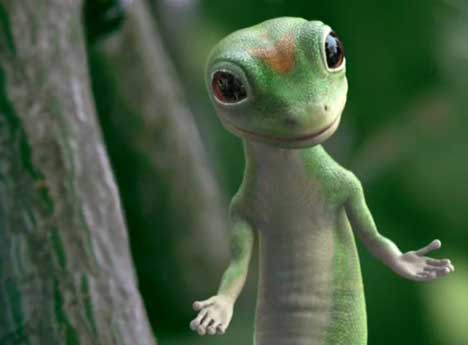
Leave me alone, I don't want your damn insurance!
And there ya have it, Asian house geckos. I wish there was a bit more info on them. Surprisingly it's rather sparse aside from what I have and pet care tips. Oh well, some info is better than none. It was a lot better than that damned Japanese spiny rat, though.
~Zoo
